MaaS
Modularity as a Service©
Variable capacity and passenger transfer without getting off:
This is how modularity changes the paradigm of mobility. A network of collaborative vehicles creating modular mobility as a service, a true | Internet of Mobility.
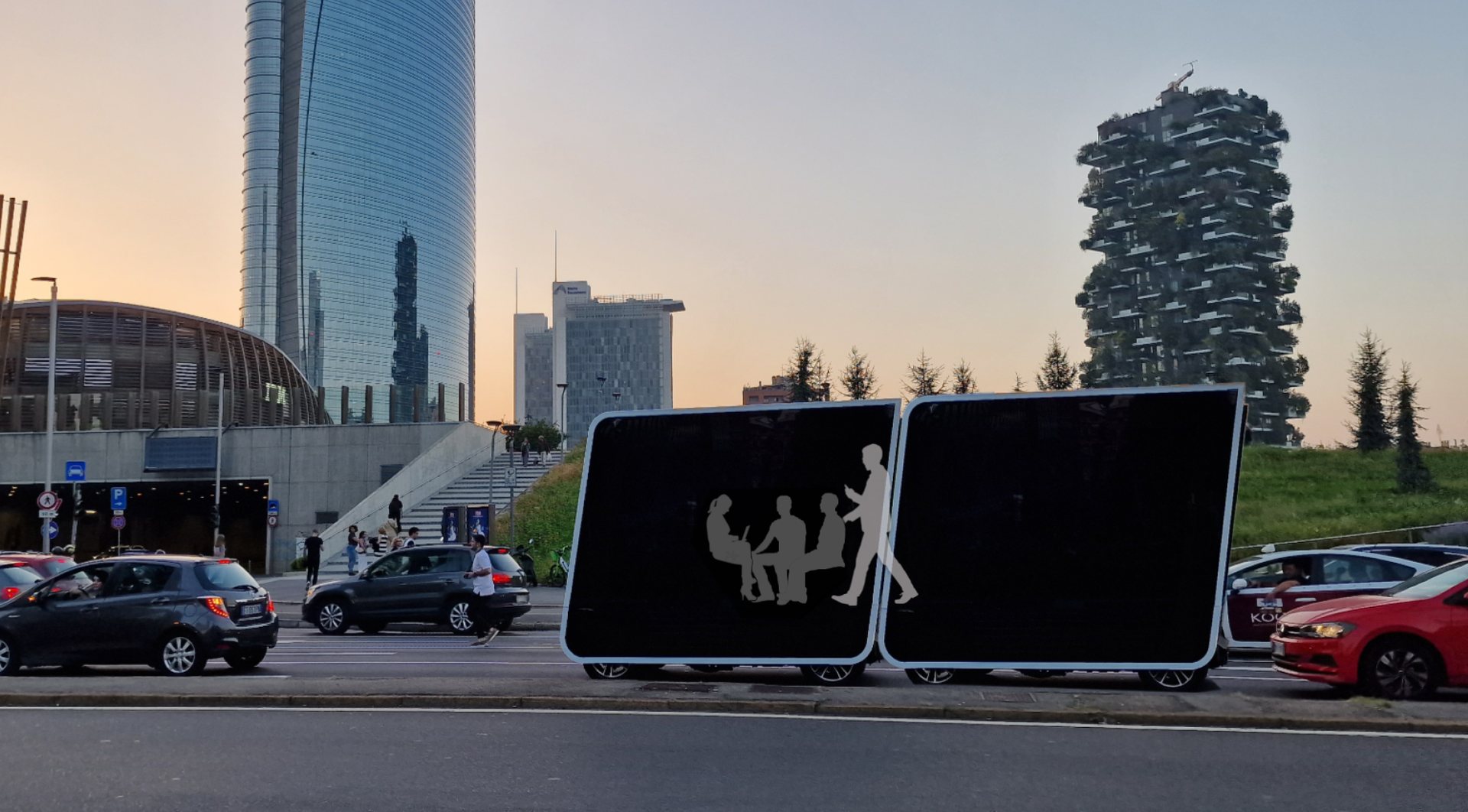
In-motion transfer
| The connection made in motion, no getting off, no waiting, no stress.
Capacity follows demand
Peak hours: one 18 m e-bus = five coupled pods. Low demand: one pod in service | the others charge or do car-sharing. Up to −80% traffic and −60% CO₂ per passenger, certified by Solar Impulse Efficient Solution.
Real footage
Docking at speed on a public road, moving between modules, undocking at full speed. Alignment and docking are already automated (L2). L4 autonomous driving is under development, available on request in dedicated areas.
Padova
The geometry
Solving the first- and last-mile problem by exploiting the star geometry of the city. Multiple vehicles pick up people on demand in the outskirts and the province, where public transport is scarce. Along the main arteries they join up and group the passengers heading downtown. The few full pods reach the center without adding traffic, while those now empty are free to collect new passengers out in the province. Everything happens symmetrically on the way back, in the evening.
It is the principle of the paper that opened the field | Gecchelin & Webb, 2018.
Same demand, two geometries: in series vs in parallel
Parallel pooling
You board with different destinations; at the exchange each one moves, without getting off, into the module going their way.
No fixed hubs required.
Different destinations at the start → transfer between modules → convoys optimized by destination
The fleet control room
The NExT software simulates and governs the fleet in real time: demand distribution and peaks, couplings, passenger transfers, charging, driver shifts, predictive maintenance.
The fleet can be planned and managed in natural language.
| e.g. "send all pods to charge for the next peak"
| e.g. "there's a concert at Wembley Stadium, reorganize the fleet around the forecast peaks"
| e.g. "it's a rainy Sunday before Christmas, create a line to ease the traffic toward IKEA"
It's part of the NExT software suite.
NExT MaaS Platform · built in-house
Compared
| NExT · modular pods | Classic electric bus | Classic DRT / pooling | |
|---|---|---|---|
| Capacity | Follows demand, 1 to 5 pods | Fixed | Fixed (van) |
| Off-peak | Only the pods needed, the rest charge | Runs half-empty | Van runs half-empty |
| Passenger transfer | Between coupled modules, no getting off | None | Transfer at a fixed hub |
| Detours | No shared detours, opens into a star | Fixed route | Shared detours |
| Empty seats | Up to −84.9% (Tongji) | High off-peak | High at low demand |
| Driver | With driver today, L4 in development | With driver | With driver |
At equal demand
The numbers of research
Over 80 peer-reviewed studies, none commissioned by us: sources and quotes on the Research page.
Common questions
To go deeper into MaaS and our fleet management software, and to see the pods in person:
Request an invitation Discover the podAre you an operator?